
THE PIT AT DERI ROAD
If you follow the winding route from Porth to Tylorstown, you’ll pass a little valley hollow called Deri Road, near the Rhondda Fach River. Most of it is modern housing now terraces, corner shops, playgrounds, but fifty years ago the area was still scarred with black spoil tips and the thin chimneys of the colliery works.
Down in one of those rows stood Number 39, a narrow house with peeling green paint, where a story unfolded that local still swear was true.
Part One — The Voice in the Walls
In 1978, a young couple, Rhian and Glyn Rees, moved into Number 39. He was an engineer at the local pit, and she worked in a bakery. The rent was cheap, the railway was close, and the neighbours were kind, the usual comforts of life in the valleys.
Their first odd experience came that autumn. Rhian told friends that while cleaning one morning, she heard a man’s voice behind the kitchen wall. It sounded muffled, but the words were clear, something like: “Not yet… keep the lamps.”
She knocked on the wall, thinking a neighbour was joking, but the sound came again, closer, as if from inside the plaster itself. The cat hissed, and every cereal bowl in the cupboard rattled at once.
Glyn dismissed it as pipes or wind through the chimney. But two nights later, when he went down to the coal bunker behind the house, he smelt smoke. Thick, sharp, like burning oil. Then he heard coughing, human coughing, coming from inside the wall. When he pressed his ear against the bricks, the coughing stopped.
Part Two — The Man in the Cellar
The landlord said the house had once belonged to a pit supervisor named Evan Price, who had died during a cave‑in decades earlier. His family left soon after, and the place had been rented out to miners ever since.
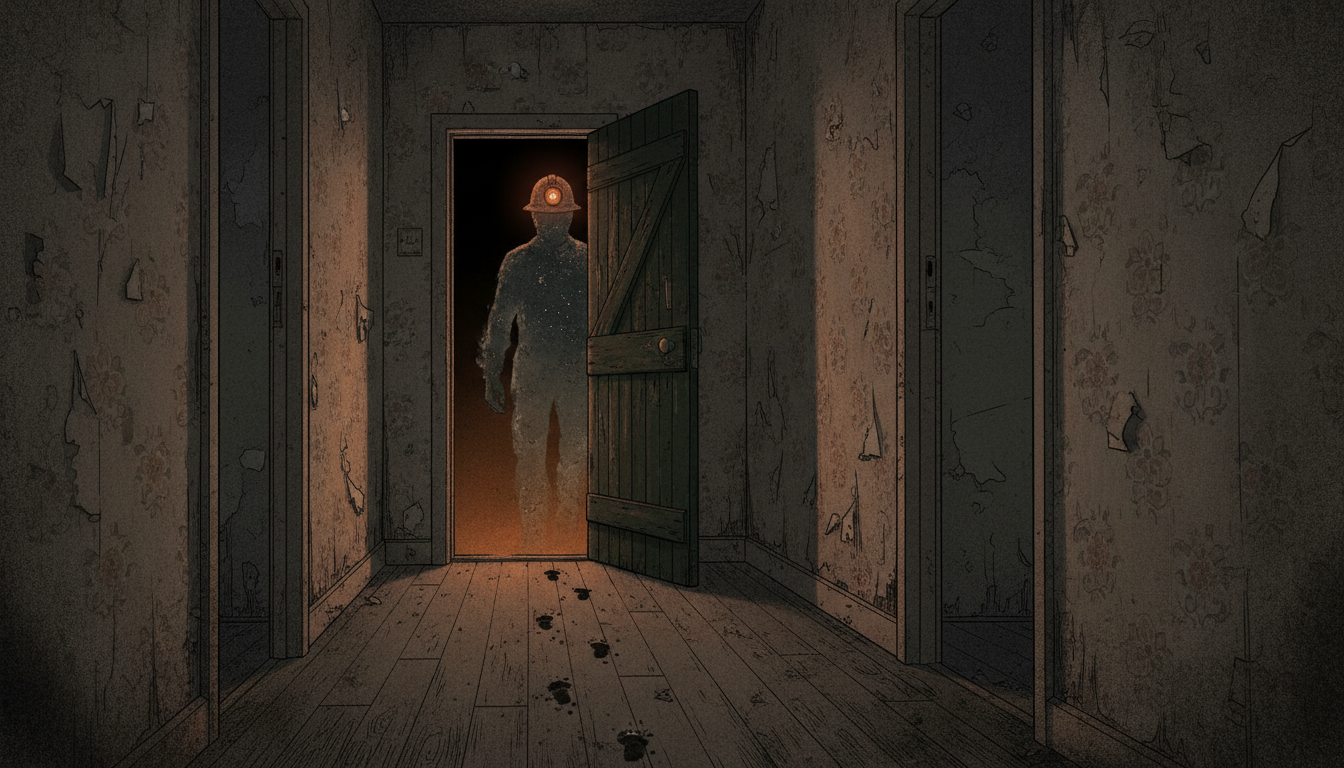
Rhian began finding coal dust scattered across the stairs each morning. No matter how many times she cleaned, the trails returned overnight, small, black footprints leading from the kitchen down to the cellar door.
That door always swelled with damp and had to be forced open, but one cold week in December, it started creaking in the night, opening all on its own.
Finally, Glyn decided to bolt it shut.
When he hammered the last nail in, he swore he heard something behind it, three knocks, slow and deliberate, followed by what sounded like a sigh.
They thought that would be the end of it. But that night, while Rhian slept, Glyn woke to the sound of someone walking down the stairs.
Soft boots. Gravel crunch.
He grabbed a torch and crept down, and there, halfway between the hall and the kitchen, saw a man at the bottom step.
Not solid exactly. More like a shimmer in the air, a miner’s shape. The outline of a helmet, lamp still burning faintly in the dark, dripping candle grease that sizzled as it hit the floor.
When Glyn raised the torch, the figure turned, and the face he saw was soot-covered but unmistakably human. Then it was gone.
Part Three — The Rescue That Never Was
The next day, Glyn asked the oldest man in the street, Ivor Thomas, about the pit accidents down by Deri. Ivor nodded sombrely.
“Aye, that was Evan Price you’ve seen, most likely. He was a deputy in the No. 3 drift. They say he went down to fetch trapped lads in ’43… never came back. They sealed that section to stop the gas spreading. Said they’d dig him out later, only they never did.”
That night, Rhian dreamed of voices murmuring through the floorboards, men calling to each other underground. When she woke up, the air was freezing, and a film of fine black dust covered the sheets like soot. Outside, the wind howled strangely each gust sounding like a deep breath drawn through rock.
Over the next week, the house filled with odd smells, candle wax, coal smoke, wet wood. Glyn tried to stay awake each night to catch the cause, but one evening, he dozed off in his armchair, until the wireless snapped on by itself.
It played the emergency broadcast tone used at the collieries when danger gas was detected, a sound no one in the valley could mistake. Then, underneath that alarm tone, came three distinct knocks, booming, like tools striking stone.
Part Four — The Pit Returns
The final night in Number 39 came soon after. It was late January, freezing, snow falling hard. Rhian was folding clothes when the electricity cut out. Glyn went to light a candle and saw something move in the corner.
The cellar door, nailed shut with two iron bolts, was wide open.
From the darkness below came a dim orange glow, faintly flickering, a miner’s lamp.
And voices. Dozens of them. Calling from deep below:
“Lift him… here, lad… keep the flame.”
Rhian swears she saw men, shadows in helmets, shoulder to shoulder, appearing from the cellar one by one, carrying something between them. When lightning flashed, she realised what it was: a stretcher, with a body laid across it.
They carried it through the kitchen and vanished into the wall by the fire, where the voices had first been heard. The air smelled of smoke and damp wool.
Then silence.
When Glyn dared to look, the cellar light had gone out. Only the nails from the cellar door lay scattered on the kitchen floor, warm to the touch, as if they’d been held.
Epilogue — The Fire in the Ground
After that night, the couple moved to Pontypridd. The next tenants stayed only a month. Reports began about strange lights beneath the garden and knocks echoing under the pavement at midnight.
When council workmen finally dug up part of the road to replace water mains, they found a collapsed access tunnel, timbered walls, long sealed, that was never recorded on modern maps. Among the debris lay fragments of tools and a nameplate etched with “E. PRICE, DEPUTY.”
The tunnel lay directly beneath Number 39.
The workmen called it a forgotten air course from the old No. 3 drift. The coroner, long ago, had marked Evan Price as “presumed lost.”
But in the valley today, some still say that when the night is still and the wind drops between the hills, you can hear mining picks under Deri Road, the rhythm steady, deliberate. Men stuck down the pit.
Three knocks. A breath. Then silence.
And if you ever smell lamp oil or coal smoke where there shouldn’t be any, the old-timers will tell you quietly:
“That’s just Evan, checking the lamps.”